

Lumbar Spondylolisthesis: Symptoms, Diagnosis and Treatment
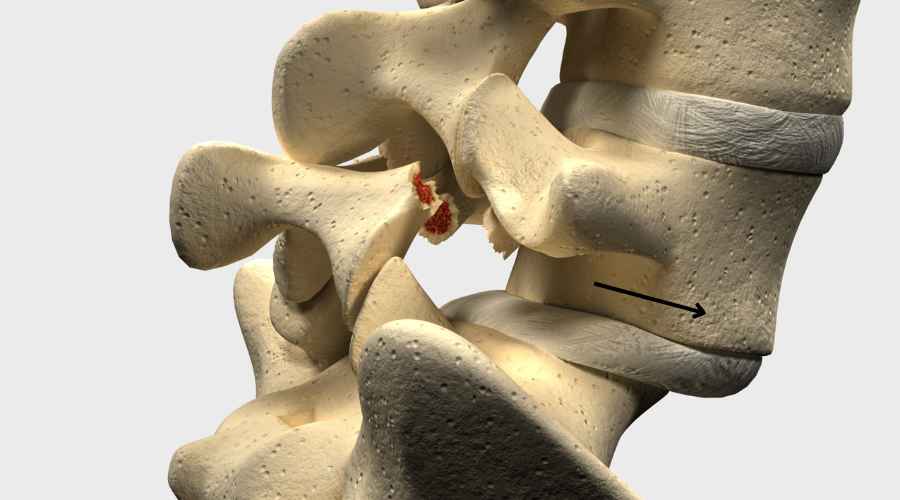
Lumbar spondylolisthesis is a condition in which one vertebra slips forward relative to the one below it, most commonly at the L4–L5 or L5–S1 levels.
This alteration can be classified into two main types:
- Degenerative, caused by the progressive wear and tear of the facet joints and intervertebral discs associated with aging.
- Isthmic, due to a defect or fracture of the vertebral isthmus (pars interarticularis), often resulting from repeated microtrauma.
Symptoms range from chronic low back pain and stiffness to radiating leg pain (radiculopathy), muscle weakness, or tingling sensations when nerve compression is present. Pain tends to worsen when standing, walking, or extending the back, while it improves with rest.
Among the main risk factors are aging, obesity, repetitive strain on the spine (such as in gymnastics or weightlifting), and genetic predisposition.
Diagnosis
Diagnosis begins with a thorough clinical evaluation, which includes:
- Analysis of posture and spinal alignment
- Observation of gait and mobility
- Neurological examination to assess strength, sensation, and reflexes
X-ray imaging (including flexion and extension views) allows measurement of the degree of slippage according to the Meyerding classification (Grade I–IV).
MRI (Magnetic Resonance Imaging) evaluates nerve root and soft tissue compression, while CT scan helps identify bony defects such as fractures of the pars interarticularis.
Conservative Treatment
Initial treatment is generally non-surgical and aims to reduce pain and stabilize the spine. Available options include:
- Fisioterapia per rinforzare la muscolatura del core e migliorare la postura
- Nonsteroidal anti-inflammatory drugs (NSAIDs) to control pain and inflammation
- Activity modification to avoid movements that overload the lower back
- Orthopedic braces in cases of isthmic spondylolisthesis
- Epidural corticosteroid injections, useful for relieving radicular pain
With an appropriate conservative approach, many patients achieve significant symptom improvement.
Surgical Treatment
L’intervento chirurgico è indicato in caso di:
- Progressive slippage (Grade II or higher)
- Instabilità vertebrale marcata
- Persistent neurological deficits
The goals of surgery are to decompress the nerves and stabilize the spine.
The most commonly used techniques include:
- Laminectomy to relieve compressed nerve structures
- Spinal arthrodesis (spinal fusion) using different approaches, including TLIF (Transforaminal Lumbar Interbody Fusion) and ALIF (Anterior Lumbar Interbody Fusion)
Minimally invasive techniques reduce tissue trauma, blood loss, and speed up recovery times.
According to studies, 70–85% of patients report a significant improvement in pain and function after spinal fusion, although adjacent segment degeneration may occur in the long term.
Rehabilitation and Lifestyle
The post-operative rehabilitation è fondamentale per il successo a lungo termine.
It includes:
- Lumbar strengthening and stabilization exercises
- Low-impact physical activity (walking, swimming, stationary cycling)
- Body weight control
- Smoking cessation, as it negatively affects bone healing
Adopting a healthy and active lifestyle helps maintain results and prevent new spinal problems.
Conclusions
Lumbar spondylolisthesis is a common condition but can be successfully treated with a personalized approach.
An early evaluation by a spine specialist makes it possible to identify the most appropriate strategy — conservative or surgical — based on the severity of the slippage, the patient’s symptoms, and individual goals, ensuring the best possible recovery and the long-term protection of spinal health.