

Eccellente Stabilità
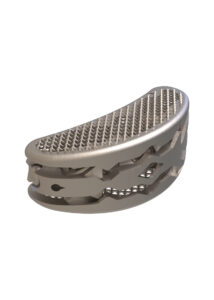
Additive manufacturing technology, combined with a unique implant geometry, enables efficient and reliable primary and secondary fixation.
The unique "network" structure ensures high primary stability and reduces the risk of implant migration. The implant's elastic modulus is comparable to that of PEEK alternatives and is close to the characteristics of natural bone, a key factor in promoting osseointegration and bone growth.
Secondary fixation is supported by a rapid and effective osseointegration process.
Wide Range of Sizes
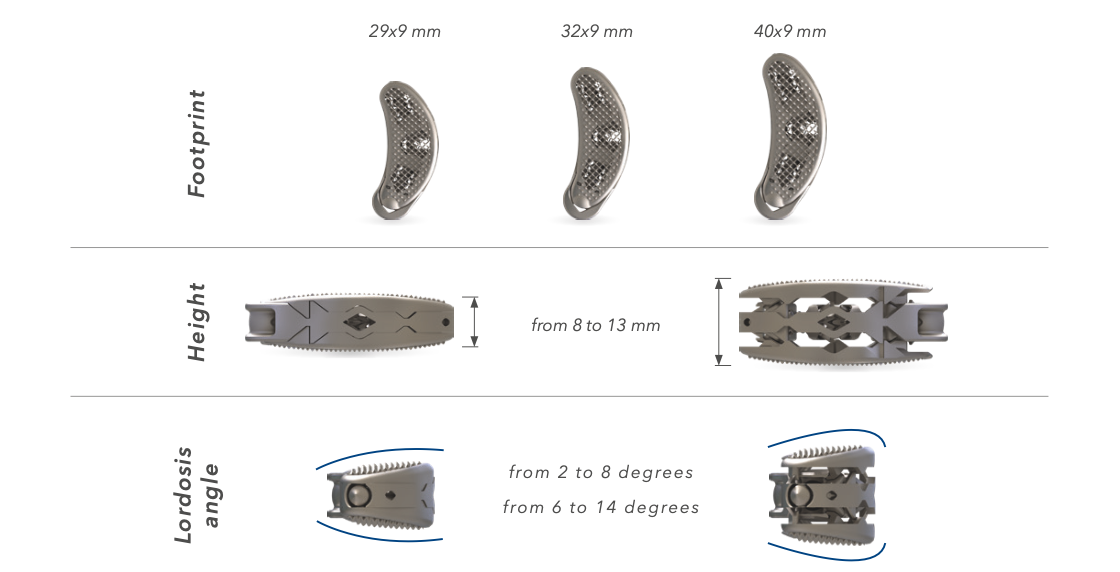
The design concept for the Ustica 3D-printed TLIF cage was developed to meet the needs of experienced surgeons. Tsunami Medical offers implants with a wide range of footprints, heights, and lordosis angles, allowing for a single system that adapts to the patient's natural anatomy and surgical preferences. For the Ustica, Tsunami Medical offers three footprints and a height range of 8 to 13 mm, with lordosis angles ranging from 2° to 14°, thanks to the innovative expansion feature.
Bone InGrowth Technology®
Ustica, a 3D-printed TLIF cage, features a unique mesh structure and a semi-open internal design, which allows for extensive colonization by new bone tissue. Both the pore size of the mesh structure and the surface roughness of the implant margins comply with the ideal parameters described in the scientific literature to promote rapid and effective osseointegration. The elasticity of the 3D-printed titanium geometry promotes rapid new bone formation and represents an excellent platform for Bone InGrowth technology. Should the surgeon deem it necessary to combine a bone growth accelerator, Tsunami Medical's Universal Filling System effectively supports the filling procedure with bone substitutes, both in the pre-implantation and post-implantation phases of the surgery.
Funzionalità di Espansione Aggiuntiva
Ustica features a unique multidirectional expansion mechanism: it allows for active cranio-caudal height expansion and adaptation to the required lordosis angle through passive adjustment of the implant's cranial and caudal contact surfaces, in accordance with the patient's natural anatomy.
Thanks to this feature, the surgeon can achieve optimal implant adaptation to the individual anatomy or restore sagittal balance at one or more affected levels.
Both implant placement and individual expansion functions are performed using the same implant introducer, without the need for additional instruments. In addition to ensuring ease of use and reduced surgical time, this solution contributes to increased patient safety and comfort.